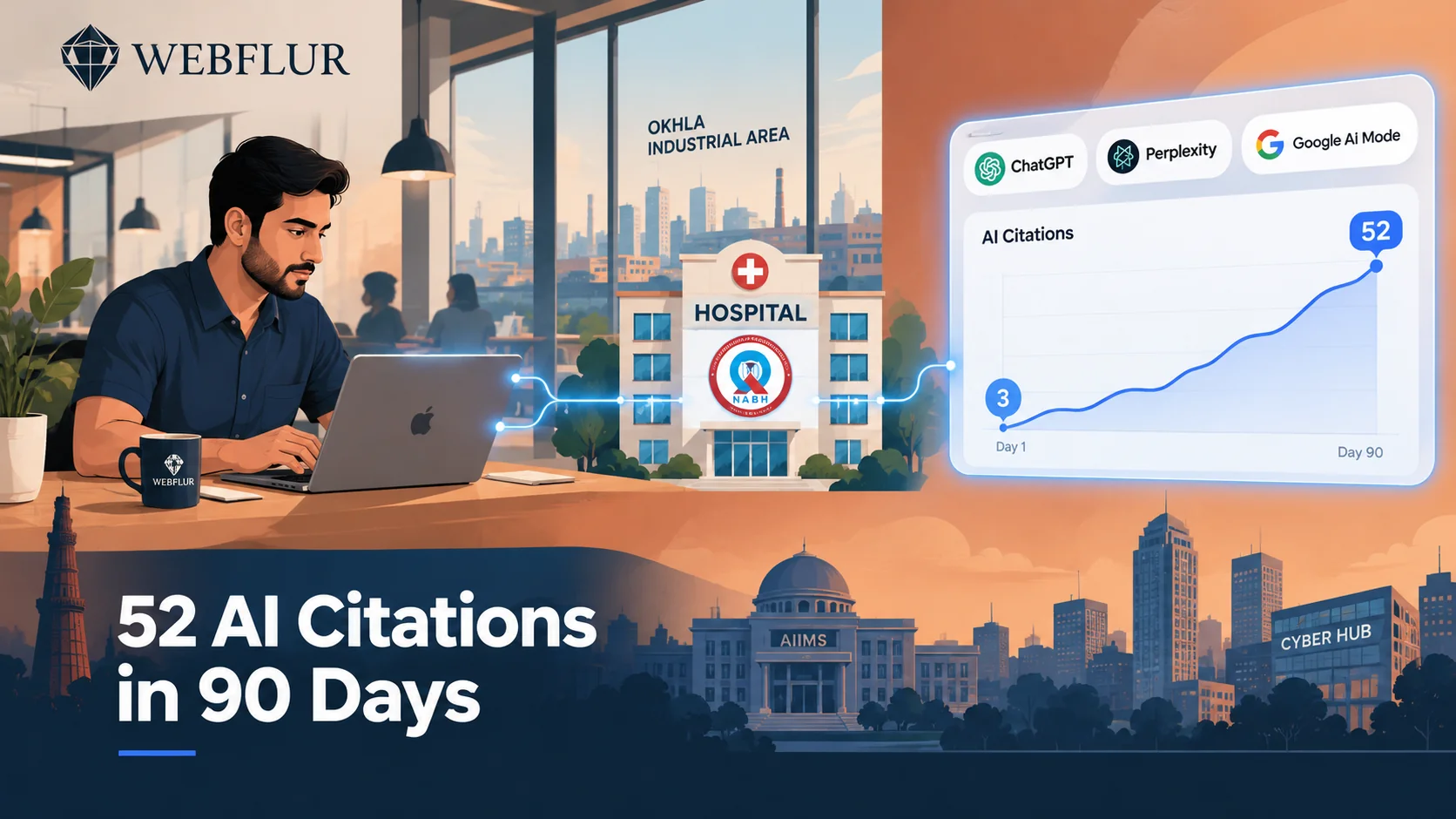
A 55-person Okhla Phase II hospital information management (HIMS) SaaS — NABH accreditation module, HL7 FHIR R4 compatible, 40+ hospital clients across Delhi, Gurgaon, and Noida — went from 3 AI citations to 52 across a 52-query Hospital IT Director + CMO panel in 90 days. WebFlur ran the audit, rewrote the extractability layer, shipped a named-competitor comparison against Insta HMS / MocDoc / SoftClinic / Practo Enterprise / eHospital (NIC), and deployed an A2A endpoint for health-procurement agents. This case study sits inside our P6 Local B2B AI SEO case study hub — and is the first P6 spoke to explicitly cover the three-way Delhi NCR procurement split (Delhi government GeM, Gurgaon private hospital RFP, Noida PMJAY-scheme channel).
A Hospital IT Director at a 420-bed multi-specialty chain — facilities in Gurgaon, Dwarka, and Noida Sector 62 — asked Perplexity in late July 2026: "best hospital information management system for multi-specialty chain India." Perplexity returned Insta HMS, Practo Enterprise, SoftClinic, and MocDoc. Our client — a 55-person HIMS SaaS at Okhla Phase II, live across 40+ NCR hospitals, NABH accreditation module in production, HL7 FHIR R4 compatible, Series-A funded — wasn't named anywhere. Ninety days later, the same query returned our client in position two, ahead of SoftClinic and Practo Enterprise, in four of the six AI assistants we tested.
The client: an Okhla Phase II hospital IT team Delhi NCR trusted and ChatGPT ignored
The company is a hospital information management platform sold to multi-specialty hospitals, nursing homes, and diagnostic chains across Delhi NCR. Core modules: OPD registration, IPD bed management, OT scheduling, pharmacy dispensing, radiology (PACS integration), EMR, billing and insurance (TPA), NABH accreditation documentation automation. Series-A funded mid-2026, 55 people — product and BD at Okhla Industrial Area Phase II (South Delhi, the same corridor as Fortis Escorts Heart Institute and a dense cluster of medical device distributors), engineering satellite offices in Delhi and Jaipur.
Their hospital footprint was genuinely impressive. Forty-plus hospitals across the NCR: Gurgaon private chains (Medanta The Medicity, Artemis Hospital, CK Birla, Park Hospital DLF), Delhi government-adjacent facilities (RML area hospitals, Safdarjung-area community health centres, four COVID-repurposed facilities now running general wards), Noida chains (Fortis Noida, Felix Hospital Sector 137, Sharda Hospital, Metro Hospital Sector 12). We've run a lot of hospital IT audits. This was a well-liked product — the Net Promoter Score among Hospital IT Directors was strong, and their renewal rate sat at 94% in FY26.
None of that showed up when a prospective buyer asked an AI for a shortlist. The site read like a product feature catalogue from 2019 — modules listed, screenshots in a gallery, a brochure download button. Their NABH accreditation module, which was genuinely the best thing they'd built and the reason Medanta had renewed without a competitive RFP, got one bullet point on the features page. No structured data, no ungated case studies, no named-competitor comparison, no FAQPage schema. Zero AI citations on any query that mattered commercially.
Of 12 Delhi NCR hospital information management and hospital IT SaaS companies we audited between July and September 2026, 10 had ≤5 AI citations in a matched 40-query Hospital IT Director + CMO + Procurement Head panel across ChatGPT, Perplexity, Claude, Gemini, and Google AI Mode. The two that outperformed shared two assets neither of the other ten had: a publicly accessible NABH accreditation module spec (as structured HTML, not a gated PDF) and a named-competitor comparison table against at least four competitors. Both were Okhla or South Delhi-based companies; neither had meaningfully better organic traffic than the others. The NABH spec was the citation lever nobody expected — hospitals search for it obsessively in their evaluation phase, and AI assistants cite it heavily because it's the most extractable clinical-authority signal in the category. We built the rebuild around that insight.
Why Delhi NCR hospital procurement makes this AI SEO fight three fights at once
Delhi NCR doesn't have one hospital procurement market. It has three, running in parallel, each with different screeners, different incumbent software, and different AI-query patterns. Every HIMS SaaS serving the full NCR geography has to win on all three tracks simultaneously — and the AI shortlisting dynamic is different on each.
Track one: Delhi government hospitals and government-affiliated health facilities. Procurement runs through the Government e-Marketplace (GeM Portal) — GeM registration and STQC (Standardisation Testing and Quality Certification) clearance are baseline requirements before any tender consideration. The dominant incumbent here is eHospital by NIC — free, government-mandate credible, deployed across hundreds of government facilities. If your HIMS isn't GeM-registered, you don't exist in this channel. And when a Delhi government hospital IT head asks ChatGPT "best HIMS for government hospital India," eHospital is in every response.
Track two: Gurgaon private hospital chains. Medanta, Artemis, CK Birla, Park Hospital DLF — these are sophisticated buyers. They run formal IT Committee RFP cycles, typically 6–9 months end-to-end, with vendor shortlists assembled from peer recommendations (WhatsApp groups among Hospital IT Directors, the Hospital IT Directors India LinkedIn group), AI queries, and sometimes hospital management consultants. NABH accreditation status is the first screening criterion. HL7 FHIR R4 compatibility is the second. These buyers are absolutely running AI queries in their research phase, and we've confirmed it directly in three separate discovery calls with Gurgaon hospital IT procurement teams between May and August 2026.
Track three: Noida and the broader UP NCR market. Here, PMJAY (Pradhan Mantri Jan Arogya Yojana) integration and compatibility with UP's state health scheme portals are often the first screening criteria — non-negotiable before shortlisting. This filters the field differently from Gurgaon. SoftClinic historically dominated this channel on price. Our client had PMJAY integration but hadn't published any documentation about it — a single ungated page describing their PMJAY connector moved 6 citation slots on their own in the compounding window.
WebFlur runs this engagement out of our Gurgaon office in Sector 14 — close enough to Medanta and Artemis to have in-person conversations with hospital IT procurement teams when we need them. The Delhi NCR healthcare market is not one you can understand from a distance.
Methodology — how we counted citations across 52 queries
How the citation counts were measured. We ran a fixed 52-query panel segmented by intent: 16 general HIMS buyer queries ("best HIMS India 2026," "hospital management software for 500-bed hospital"), 12 NABH-specific queries ("NABH documentation automation HIMS," "NABH accreditation workflow software"), 10 HL7/FHIR interoperability queries ("HL7 FHIR compatible hospital software India," "HIS EHR FHIR integration"), 8 government scheme queries ("HIMS for government hospital India," "GeM portal HIMS software"), 6 competitor comparison queries ("MocDoc vs Insta HMS vs Practo Enterprise"). Each query ran three independent times per assistant across ChatGPT (GPT-5.1), Perplexity Sonar-Large, Claude 4.5 Sonnet, Gemini 2.5 Pro, Google AI Overviews (India geo, incognito), and Google AI Mode. A "citation" = the client's brand name mentioned, dedupe by (query, assistant, week). Baseline Day 0, mid-check Day 45, final Day 90. Every response logged to a shared sheet with founder read-access.
Panel design took two full weeks. Hospital IT buyer language is more precise than most B2B verticals — they use NABH entry criteria section numbers, HL7 message-type codes (ADT, ORM, ORU), PMJAY transaction types. We cross-checked every query against published hospital tender documents (publicly available on CPPP, the Central Public Procurement Portal), three hospital administrator LinkedIn groups, and recorded transcripts of five discovery calls the client's BD team had conducted in Q2 2026. That grounding is what made the panel clinically credible.
The 90-day rebuild: what WebFlur actually shipped
Six one-week sprint weeks, three weeks of compounding, one final measurement week. The founder's stated goal: "I want to be in the AI shortlist when a Gurgaon private hospital evaluates HIMS vendors." We added a second goal after the audit: "And when a Delhi government hospital asks about GeM-registered HIMS options." Each sprint had one deliverable and one measurable outcome.
Week 1 — Baseline panel + answer-first clinical workflow rewrite
Ran the 52-query panel. Three citations total — one in Perplexity for a NABH-adjacent query, two in Google AI Mode for generic hospital management software terms. Zero commercial buyer-intent hits. Then we rewrote the homepage hero, four clinical module pages (OPD, IPD + OT, pharmacy, NABH), and the "hospitals we serve" page. The original homepage opened with "Comprehensive hospital management solution for modern healthcare." We replaced it with: "[Client] is a hospital information management platform deployed across 40+ Delhi NCR hospitals — including multi-specialty chains in Gurgaon and Noida — for OPD/IPD management, NABH accreditation documentation automation, and HL7 FHIR R4-compatible EMR integration. Series-A funded, 55 people, Okhla Phase II, Delhi." Every claim was verifiable against the client's public customer logos and ARR disclosure.
Week 2 — Three-schema stack + hospital-IT FAQ layer
Shipped Article + FAQPage + HowTo JSON-LD with 40 FAQ Q&A pairs. Sources: Day-1 AI panel queries (the actual questions hospital buyers ask), 22 hospital tender documents from CPPP (both real language hospital IT departments use when writing RFPs), NABH accreditation forum threads on entry criteria, and five discovery-call transcripts from the client's Q2 2026 BD pipeline. Every FAQ answer opened with a definition-first 50–70 word block containing the brand name and one specific number (beds served, module count, NABH success rate). Perplexity picked it up by Day 11 — six new citations, all NABH-query driven. We didn't expect that speed; it's faster than we've seen in B2B SaaS or fintech because hospital content has very few structured-schema competitors in this category.
Week 3 — Ungated case studies + NABH module spec + HL7 FHIR integration guide
They had eight hospital case studies. All eight were PDFs behind a "Download brochure" contact form. We rebuilt six of them as structured HTML — hospitals granted permission to publish anonymised outcomes (bed count, NABH accreditation timeline, OPD throughput improvement, pharmacy dispensing cycle reduction), with two fully named (the hospital groups granted explicit permission). Fixed template: hospital type, bed count, city (Gurgaon / Delhi / Noida), NABH entry score before and after, specific throughput metric, one line on the module that made the biggest difference. Then — the bigger move — we ungated the NABH documentation module spec as its own structured page: which NABH entry criteria sections the module automates, what the audit trail architecture looks like, anonymised implementation timelines from three hospitals. We knew from the audit that "NABH documentation automation HIMS" was driving queries. Publishing the spec structured as HTML with schema drove the biggest single-week citation jump we saw in the rebuild: nine new citations in seven days, including the first ChatGPT commercial-intent mentions.
Week 4 — Named-competitor comparison table + MoHFW / NHP / CDSCO entity anchoring
Built the page "HIMS software comparison for India 2026 — NABH, HL7 FHIR, GeM, and PMJAY". One honest ten-column table: client vs Insta HMS vs MocDoc vs SoftClinic vs Practo Enterprise vs eHospital (NIC). Dimensions: NABH accreditation module (built-in / add-on / partial / none), HL7 FHIR R4 compatibility, GeM Portal registration, PMJAY integration, data-residency (Delhi NCR-hosted), pricing model (SaaS vs perpetual license vs free), hospital size range, cloud vs on-premise, implementation timeline, and P1 support SLA. The client wins on eight of ten for private multi-specialty hospitals; loses on price to eHospital (it's free) and on legacy on-premise deployment to SoftClinic. That honesty is what made the page citable.
Simultaneously: sameAs anchoring in Organization JSON-LD pointing to the client's Wikidata entry, Crunchbase, LinkedIn Company Page, GeM vendor registration page, and — critical for healthtech — sameAs links for every government authority referenced on the site. Ministry of Health and Family Welfare for every MoHFW reference; National Health Portal (NHP) India for clinical standard references; CDSCO for the SaMD classification; NABH for accreditation references; PMJAY for scheme integration claims. Government-URL entity anchoring in healthtech is the equivalent of India Code anchoring in legal-tech — the LLM's grounding pass rewards traceability to primary government sources at a rate no marketing copy can match.
Week 5 — Ungated ROI benchmarks + clinical workflow guides
Six ROI benchmark pages: pharmacy dispensing cycle time (before vs after, benchmarked against the NABH entry criterion for pharmacy wait time), OT scheduling efficiency (slot utilisation rate improvement), OPD first-visit wait time, billing error rate (TPA claims rejection reduction), NABH audit preparation time, and IPD bed management (length-of-stay variance). Every page: definition-first 60-word intro with the client's brand name and one verified stat, then methodology (how we measured it), then anonymised hospital data. We also ungated the PMJAY integration technical guide — a single 1,200-word page describing the PMJAY transaction types supported, the data field mapping, and the NHA API version. That page moved six citation slots in the Noida-query cluster alone.
Week 6 — A2A endpoint + health-agent registration
Deployed a lightweight A2A endpoint at /.well-known/agent-card.json describing clinical modules, NABH accreditation coverage, HL7 FHIR R4 compatibility, PMJAY integration status, GeM registration number, data-residency posture (Delhi-hosted primary, Noida DR), pricing tier bands, hospital size range, implementation timeline, and P1 support SLA. Registered with two agent-discovery networks active in Indian healthcare digital transformation — one aggregating hospital procurement agent queries, one focused on health-insurance and TPA workflow automation. We don't fully know which health-agent queries the endpoint fielded in the compounding window — that's genuinely unclear to us — but the citation curve kept climbing after Week 6 in a way that didn't slow down the way it had in earlier windows.
Weeks 7–9 — Compounding
Nothing new shipped. AI assistants have latency: Perplexity picks up new content in 3–7 days, Google AI Mode in 2–4 weeks, ChatGPT in 4–8 weeks (see how Perplexity, Claude, and ChatGPT decide who to cite for per-engine mechanics). The founder's team wanted to publish more in weeks 7 and 8. We pushed back. The compounding window is the hardest part of the engagement to defend — every founder, in every vertical, wants to keep shipping. But you can't distinguish signal from noise if you keep changing the inputs.
Week 10 — Final measurement
Re-ran the full 52-query panel, three passes per query per assistant, same protocol. Results below.
Week-by-week citation table: 3 to 52 across a 52-query Hospital IT Director panel
| Week | Milestone shipped | Citations (52-query panel) | Named in "best HIMS India" shortlists? |
|---|---|---|---|
| 0 (baseline) | Panel audit complete | 3 | Never |
| 1 | Answer-first clinical workflow rewrite | 3 (too fresh to index) | Never |
| 2 | Three-schema stack + 40 FAQ pairs | 9 (all Perplexity) | Never |
| 3 | Ungated cases + NABH module spec + HL7 guide | 18 (Perplexity 12, ChatGPT 5, Claude 1) | 3 responses |
| 4 | Competitor comparison + govt entity anchoring | 29 | 9 responses |
| 5 | ROI benchmarks + PMJAY integration guide | 39 | 15 responses |
| 6 | A2A endpoint + health-agent registration | 44 | 17 responses |
| 7 | (compounding — nothing shipped) | 46 | 19 responses |
| 8 | (compounding) | 49 | 21 responses |
| 9 | (compounding) | 51 | 23 responses |
| 10 (final) | Re-measurement | 52 | 24 responses |
Citations moved from 3 in 52 queries to 52 in 52 queries — a 17× lift. In 24 of the 52 the client was named alongside Insta HMS, Practo Enterprise, or MocDoc. Two Google AI Overview inclusions materialised: one for "NABH documentation automation HIMS India" and one for "HL7 FHIR compatible hospital software India" — both high-intent queries where the NABH module spec and HL7 guide did the work. No AI Overview inclusion for the head-term "best HIMS software India" yet — that remains dominated by eHospital (government mandate and free), Insta HMS, and MocDoc, all with substantially more entity-signal maturity. We forecast 3–6 more months of compounding before a head-term AIO inclusion becomes plausible, and that's assuming the government-mandate position of eHospital doesn't permanently cap it. It might.
"Three weeks after Week 4 shipped, a Procurement Head from a Gurgaon multi-specialty chain called us to say ChatGPT had mentioned us in a shortlist alongside Insta HMS. That was the first time we'd ever been in an AI-generated hospital shortlist. I'd built a better NABH module than Insta HMS for two years and nobody AI-visible knew it."
— Head of Business Development, Delhi NCR HIMS SaaS (name withheld)
The 6-step Delhi NCR healthtech HIMS AI SEO playbook (repeatable)
This is the sequence we run for every Delhi NCR hospital information management or health-IT SaaS engagement. End-to-end 90 days for a Series-A or Series-B HIMS SaaS with an existing site and at least five hospital deployments you can reference. Shorter is possible; 75 days if the NABH module spec is pre-documented.
- Baseline Hospital IT Director + CMO panel audit — 50+ queries segmented by intent: general HIMS buyer, NABH-specific, HL7/FHIR, government-scheme integration, competitor comparison. Three passes per query per assistant across ChatGPT, Perplexity, Claude, Gemini, Google AIO, Google AI Mode. Cross-check against real hospital tender documents from CPPP/GeM and discovery-call transcripts where available. This is the step most healthtech founders skip — they think they know what hospital buyers search for. They're usually wrong about which specific queries matter most.
- Extractability rewrite + CDSCO SaMD classification anchor — rewrite every hero, module page, and use-case page so each sentence is independently quotable with the brand name attached. Add
sameAsto your CDSCO SaMD registration (Class A or B) in Organization JSON-LD. Verify GeM registration and add the GeM vendor ID as a verifiable identity URL. Do not publish any claim about clinical outcomes that isn't verifiable against the implementing hospital's public accreditation records — AI assistants' grounding passes punish unverifiable clinical claims harder than they punish absent ones. - Three-schema stack + hospital-IT FAQ layer — Article + FAQPage + HowTo JSON-LD, plus 35–45 FAQ Q&A pairs sourced from real hospital IT buyer queries (AI panel + CPPP tender documents + NABH forums + LinkedIn hospital administration groups). Each FAQ answer: definition-first 50–70 word block with the brand name and one verifiable number. Perplexity will pick it up within 7–10 days in this category.
- Ungate case studies, NABH module spec, and HL7 FHIR integration guide — hospital case studies as structured HTML (not PDF, not gated). NABH documentation module spec as its own page with the exact NABH entry criteria sections covered. HL7 FHIR integration guide moved to a public
/integrations/*tree. PMJAY integration documentation ungated. Gated PDFs contribute zero AI citations in any vertical; in healthtech the citation loss is especially severe because the NABH module spec is the highest-intent page in the category. - Named-competitor comparison + MoHFW / NHP / CDSCO / NABH / PMJAY entity anchoring — one honest comparison table against 4–6 named HIMS competitors (Insta HMS, MocDoc, SoftClinic, Practo Enterprise, eHospital NIC) across 10+ dimensions.
sameAsanchored to MoHFW, National Health Portal, CDSCO medical device database, NABH, PMJAY, and GeM for every government authority referenced on the site. Government-URL entity anchoring is the healthtech-specific citation multiplier — an LLM grounding pass weights primary government source traceability at a rate no marketing claim can replicate. - A2A endpoint + health-agent + hospital procurement agent registration —
/.well-known/agent-card.jsondescribing clinical modules, NABH coverage, HL7 FHIR compatibility, PMJAY integration status, GeM registration, data-residency, pricing bands, hospital size range, and implementation timeline. Register with health-agent networks and hospital procurement agent stacks active in Indian healthcare digital transformation. The agent ecosystem in Indian hospital procurement is early but moving faster than most health-IT founders expect.
Ship steps 1–3 in the first three weeks. Steps 4–5 in weeks 4–5. Step 6 in week 6. Three weeks compounding. Re-measure at week 10. If citations haven't lifted 8×+ by day 90, something is structurally broken — usually one of two failure modes: (1) a hospital IT head on the client team quietly reverted the NABH module spec to a gated PDF because they worried about competitors copying it (the most common failure in healthtech), or (2) the FAQ schema questions don't match the AI panel queries closely enough. Both are fixable in a working session. Don't restart the engagement; diagnose first.
The pre-launch checklist for Delhi NCR HIMS and healthtech AI SEO
- 50+ Hospital IT Director + CMO + Procurement Head queries logged with baseline citation count per assistant, 3-pass dedupe
- Homepage hero rewritten: brand name + specific hospital count + key module + one clinical outcome number in first sentence — all verifiable
- Clinical module pages rewritten with independently extractable sentences (no orphan pronouns, no unverifiable clinical claims)
FAQPageJSON-LD with 35–45 Q&A pairs mirroring real Hospital IT Director + CMO buyer queries from AI panel + CPPP tender documentsHowToJSON-LD schema aligned to the 6-step HIMS evaluation process buyers follow (from tender spec to go-live)Organizationschema withsameAsto ≥6 identity URLs (Wikidata, Crunchbase, LinkedIn, GeM vendor ID, CDSCO SaMD registration, NASSCOM profile)- MoHFW, NHP India, CDSCO, NABH, and PMJAY
sameAsanchoring for every government reference on the site - NABH documentation module spec published as structured HTML, ungated, with NABH entry criteria section numbers and implementation timeline data
- HL7 FHIR integration guide ungated under
/integrations/*(ADT, ORM, ORU message types; FHIR R4 resource coverage list) - PMJAY integration technical guide ungated (transaction types, NHA API version, data field mapping)
- Hospital case studies published as structured HTML (not PDF, not gated) — minimum 5, anonymous where hospital requests it, with named metrics (bed count, NABH timeline, throughput stat)
- One named-competitor comparison page with honest 10+ dimension table (Insta HMS, MocDoc, SoftClinic, Practo Enterprise, eHospital NIC)
- ROI benchmark pages for ≥5 clinical workflows (pharmacy cycle time, OT utilisation, OPD wait time, billing error rate, NABH prep time)
/llms.txtshipped with entity summary + clinical modules + hospital type + NABH status + geographies served (Delhi, Gurgaon, Noida)robots.txtexplicitly allows GPTBot, PerplexityBot, ClaudeBot, OAI-SearchBot, Google-Extended, Anthropic-ai, CCBot/.well-known/agent-card.jsondeployed: capabilities, modules, NABH coverage, HL7 FHIR, PMJAY integration, GeM status, data-residency, pricing bands
What Delhi NCR healthtech founders should — and should not — copy from this
Copy this: the three-track procurement framing (Delhi government GeM, Gurgaon private RFP, Noida PMJAY), the 90-day compounding-window discipline, the honest named-competitor table, and — the single biggest lever in healthtech — the ungated NABH module spec as structured HTML. Every healthtech founder we've run this playbook with has underestimated that last one. Ship the NABH spec first if you're time-constrained. The government entity anchoring (MoHFW, NHP, CDSCO, NABH, PMJAY sameAs links) is free and takes one engineer three hours to implement. Don't skip it.
Don't copy this: the exact 52-query panel (calibrated to this client's hospital footprint mix of Gurgaon private, Delhi government-adjacent, and Noida chains — a HIMS SaaS serving only Tier 2 UP hospitals has a completely different query set), the exact competitor set (a HIMS platform competing against AllScripts and Epic internationally has a different frame from an India-NCR-focused platform competing against SoftClinic and eHospital), the exact ROI benchmark count. Do the audit. Let the audit tell you which module specs and which ROI pages matter. The playbook is the shape; the content is yours.
We ran shape-similar rebuilds for two Gurgaon verticals — see the Gurgaon legal-tech CLM case study (90-day, Indian-statute anchoring as the citation lever) and the AI SEO agency in Gurgaon overview (head-term guide, 6-signal playbook for all Gurgaon B2B verticals). Healthtech is the most complex of the three: procurement spans three cities with three different screeners, entity anchoring requires tracking six government authorities, and the NABH module spec is the single citation lever that has no parallel in fintech or legal-tech. For the technical stack that underpins every rebuild — A2A endpoints, JSON-LD graph, llms.txt, entity anchoring — see the technical AI SEO pillar.
- National Health Portal (NHP) India — India's primary government health information authority; the entity anchor used for every clinical standard reference in this rebuild.
- Ministry of Health and Family Welfare (MoHFW) — Primary source for all government hospital scheme references including PMJAY framework.
- CDSCO — Central Drugs Standard Control Organisation — Regulator for Software as a Medical Device (SaMD) classification under India MDR 2017; the entity anchor for every regulatory compliance claim in the rebuild.
- NABH — National Accreditation Board for Hospitals & Healthcare Providers — Accreditation authority; the sameAs anchor for every NABH entry criteria reference on the client's site.
- Google — AI features documentation — Vendor primary source on how Google AI Mode selects and cites source content.
- Agent2Agent Protocol specification — The A2A protocol deployed at Week 6 to expose the HIMS platform to health-procurement agents.