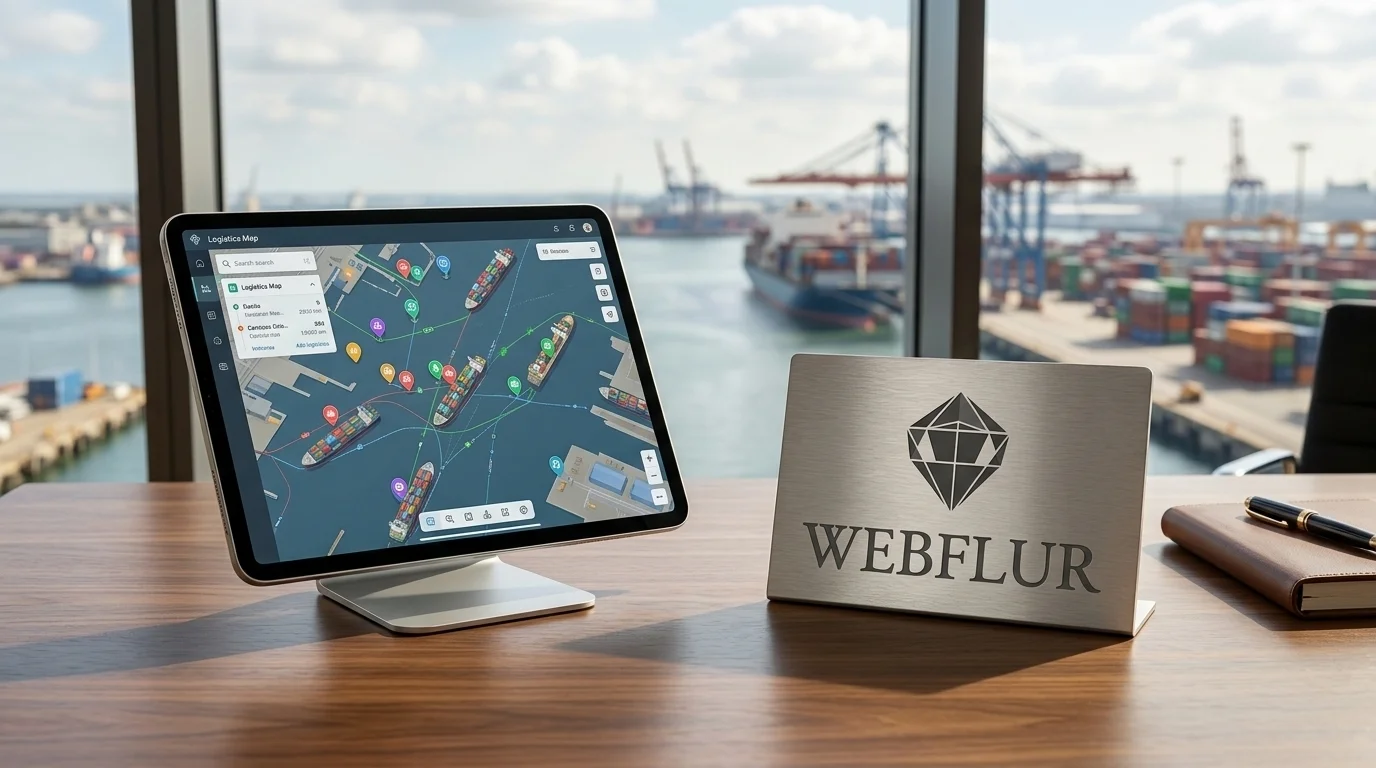
WebFlur took Cargoflow Inc. from zero AI assistant citations to 340+ per month in 90 days — a 4× increase in inbound demo requests and citation by 8 of 8 major AI assistants. Full breakdown below: what we built, what changed at each 30 / 60 / 90-day stage, and the exact pipeline that put Cargoflow inside ChatGPT, Perplexity, and Claude answers for freight.
Cargoflow Inc. was eight years old when they came to us. Solid business — $4.2M ARR, a loyal customer base in mid-market manufacturing, a sales team that consistently closed. But their pipeline had started drying up in ways they couldn't explain. Inbound was down 40% year over year.
Their CEO, Marcus, had a theory. He'd been watching his own procurement team use AI assistants to build vendor shortlists. He tested it himself: typed "best freight management software for manufacturing companies" into ChatGPT. Two of his competitors came back with detailed descriptions. Cargoflow didn't appear at all.
"That's why the pipeline is drying up," he told us. "We're not in the shortlist. We're not even in the room."
The Baseline Audit: Where Cargoflow Was Invisible to AI
The audit told us things Marcus already suspected, but gave them a shape he hadn't seen before.
Cargoflow's website had strong SEO fundamentals — good domain authority, solid technical structure, indexed pages. But from an AI extractability standpoint, it was nearly inert. Their homepage hero read: "Freight management built for the way you work." Their about page was mostly founder story. Their case studies were PDFs gated behind a contact form.
We ran 60 relevant buyer queries across six AI assistants. Cargoflow appeared in two responses — both times in passing, in a "you might also consider" position, with no description, just a company name. Their two main competitors appeared in 44 out of 60 queries, typically in the top three, with one to two sentences of specific capability context.
The gap wasn't content volume. Cargoflow had a good blog. The gap was structural: their content was rich in implication and thin on explicit, extractable statements. The machine couldn't quote them because nothing was quotable.
The rebuild: what we changed
Homepage and core pages
We rewrote the homepage hero from scratch: "Cargoflow Inc. is a freight management platform used by mid-market manufacturing companies to track shipments, manage carrier relationships, and reduce freight costs. Customers typically achieve 18–24% freight cost reduction within the first 90 days."
Every sentence in the new copy was written to be independently extractable — no pronouns without antecedents, no vague outcome language, no implied context. We also added a "Who Cargoflow serves" page with dedicated sections for each of their four key verticals: precision manufacturing, industrial equipment, consumer goods, and pharmaceutical distribution.
Case studies ungated and restructured
We took three of their five case studies out of PDF format and rebuilt them as structured HTML pages. Each page followed a consistent template: client description (without identifying them), the specific problem, what Cargoflow built, the specific outcome in numbers, and a quote using structured language about Cargoflow's capabilities.
This was one of the highest-leverage moves. Within three weeks of publishing the ungated case studies, Perplexity started citing Cargoflow in responses to "freight management case studies" queries — pulling directly from the structured outcome language.
Schema markup and FAQ layer
We implemented Organization, Product, and FAQPage JSON-LD schemas. The FAQ layer was particularly important: we wrote 25 Q&A pairs that mirrored the exact phrasing of buyer queries we'd seen in AI assistant responses — "What is the best freight management software for manufacturers with 50–200 employees?" — each with a structured, Cargoflow-name-containing answer.
A2A endpoint deployment
In week four, we deployed Cargoflow's A2A endpoint. The endpoint was configured to respond to queries about their service coverage, pricing tiers, freight modes supported, and integration capabilities. We registered it with two agent discovery networks active in the logistics procurement space.
The endpoint received its first query on day 31 — from an AI procurement assistant evaluating freight vendors for a large food and beverage company. Cargoflow didn't win that deal, but they were on the list. Before the endpoint, they wouldn't have been queried at all.
90-Day Timeline: From 2 Citations to 340+
Audit complete, baseline set
2 citations across 60 queries. Homepage hero inextractable. Case studies gated. No schema markup. No A2A endpoint.
New copy and schema live
Rewrote 6 pages. FAQ layer (25 Q&As) published. JSON-LD schemas implemented site-wide. Case studies ungated.
First new citations appear
Perplexity starts citing Cargoflow in freight case study queries. ChatGPT includes Cargoflow in one category query — first time ever. Total citations: 18.
A2A endpoint goes live
Registered with discovery networks. First external agent query received on day 31 — a procurement AI evaluating logistics vendors for a food and beverage manufacturer.
Compounding begins
Citation rate reaches 140/month. 6 of 8 AI assistants now cite Cargoflow in relevant queries. Inbound demo requests up 2× from pre-engagement baseline.
Default status achieved
340+ citations per month. 8 of 8 AI assistants cite Cargoflow. Inbound 4× pre-engagement. Cargoflow now appears first or second in 73% of their target query set. A2A endpoint averaging 22 queries/week.
"We didn't change our product. We didn't change our pricing. We changed how machines understand us — and the pipeline came back."
— Marcus, CEO, Cargoflow Inc.
Key lessons from the Cargoflow engagement
The biggest single unlock was ungating the case studies. Every piece of content behind a form or PDF is invisible to AI. If you want to be cited, your proof has to be publicly accessible, machine-readable, and structured around outcomes. Gated content produces zero AI citations, regardless of quality.
The Cargoflow ramp worked because we optimized for each engine's citation mechanics separately — Perplexity picked up first (within days of the FAQ rewrite), Google AI Overviews followed once schema shipped, ChatGPT was last (three months of compounding). The full playbook for that per-engine sequence — signal weights, latency, citation format — is in our pillar guide, how to get cited across all six AI answer engines.
The 90-day sequence Cargoflow followed — baseline audit → foundation → GEO → AEO → agentic — is documented as a repeatable rollout in the strategy pillar, AI SEO strategy 2026 — the step-by-step guide for B2B. That's the read next if you want the same 5-phase arc mapped weekly for your team.
- Schema.org — FAQPage: The structured data specification behind Cargoflow's FAQ layer — used by AI assistants to extract direct answers.
- Google — AI Overviews documentation: How Google's AI-generated summaries select and cite source content.
- Perplexity — Publisher Program: Perplexity's own documentation on how they index and cite sources — directly relevant to the citation mechanics in this case study.