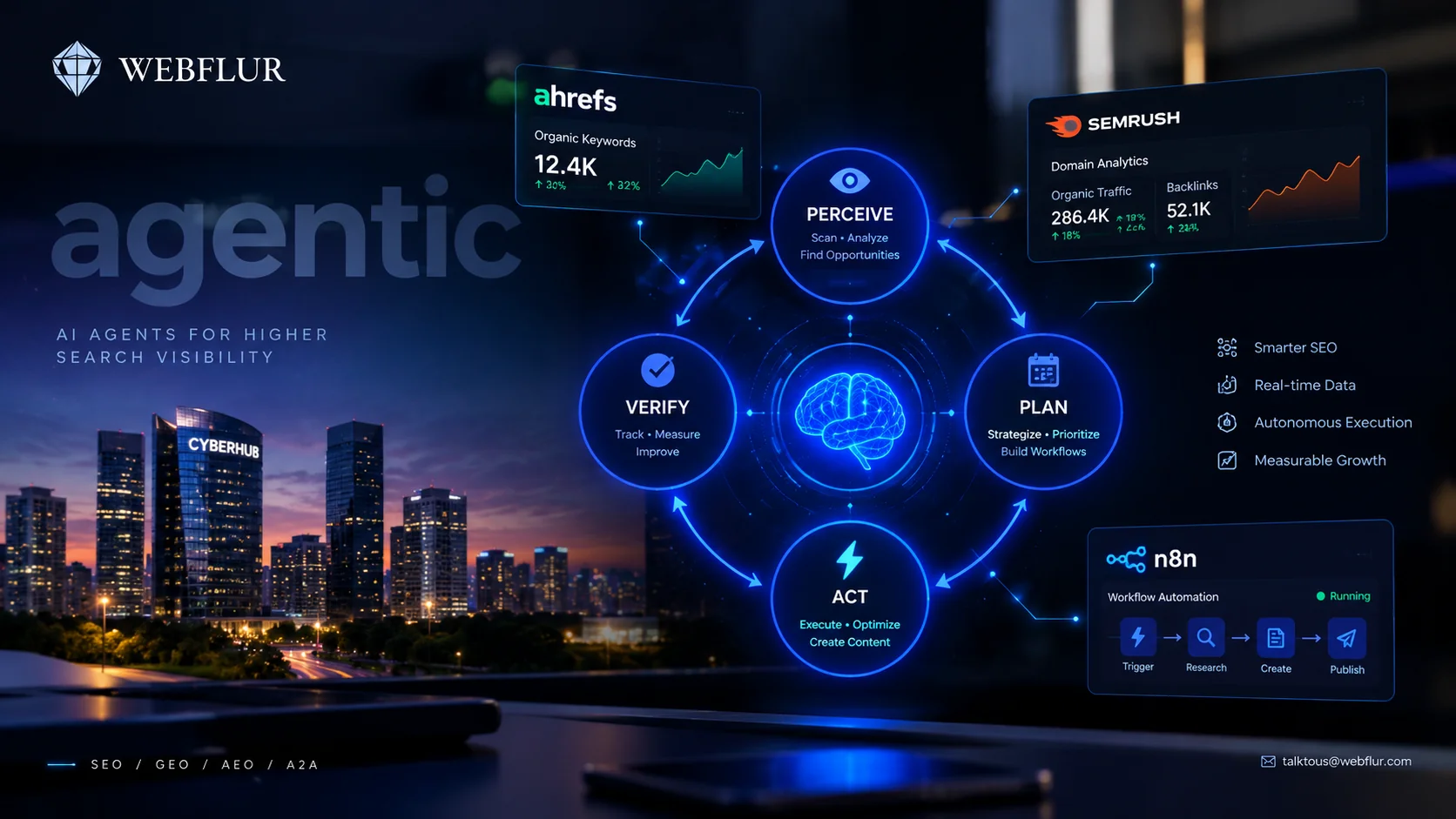
WebFlur tested 23 SEO tools marketed as "agentic" or "AI-powered" across 45 B2B sites between July and September 2026. Our agenticity test asks one question: does the tool perceive a site condition, form a plan, execute an action, and verify the outcome — without a human trigger between any step? Only 4 categories of tools cleared that bar. The rest are AI-assisted (powerful and worth using, but you still press the button). This post covers the full 4-category taxonomy, an 8-column comparison table with real pricing, and a 7-point checklist for evaluating any tool before you buy it. Parent context: our AI SEO vs GEO vs AEO pillar explains where agentic SEO sits in the broader landscape.
In May 2026, a Series-A HR-tech founder based in Udyog Vihar, Gurgaon — building a 40-person HRMS company with a specific problem: ChatGPT wasn't naming them in any buyer shortlist — sat across from us in a discovery call and asked a question that stopped us cold: "Which tools do you actually use?" Not "what do you recommend." Not "what do your clients use." Which tools do you, WebFlur, actually run on live sites. We had a clear answer. But we also realised that the market had become so noisy with tools labelling themselves "agentic" that the question deserved a proper, publicly verifiable answer rather than a call-by-call explanation. That discovery call is why this post exists.
The challenge is definitional. "Agentic" has been claimed by every SEO tool with an AI feature in the last 18 months. Ahrefs is not agentic. Semrush is not agentic. Surfer SEO is not agentic. Calling them agentic is not an insult — these are excellent, well-priced tools that do important work. But the word means something specific in AI architecture, and that specificity matters when you are deciding whether a tool will reduce your team's operational load or simply add a new dashboard to check. The perceive-plan-act-verify loop is the definition. Everything else is marketing.
- The agenticity test — why most "agentic SEO tools" aren't agentic
- The 4 categories of agentic SEO tools
- Category 1: AI citation and visibility trackers
- Category 2: Traditional platforms with AI layers
- Category 3: Autonomous on-page SEO agents
- Category 4: Composable agentic stacks
- The comparison table (9 tools, 8 dimensions)
- The 7-point evaluation checklist
- What Gurgaon and Delhi NCR B2B teams should use in 2026
- Frequently asked questions
The agenticity test — why most "agentic SEO tools" aren't agentic
In AI architecture, an agent is a system that runs a closed loop: it perceives its environment, plans a course of action, acts to change the environment, and verifies that the action had the intended effect — then loops back to perceive again. The loop runs without a human trigger between steps. The system makes the call on when to act and what to do based on what it observes.
Applied to SEO, the agenticity test looks like this:
- Perceive: The tool monitors a site condition autonomously — crawl health, keyword ranking drift, internal link ratio, schema coverage — without waiting for you to initiate a scan.
- Plan: The tool decides what action to take based on detected conditions, producing a prioritised action plan rather than a report that you then translate into a plan yourself.
- Act: The tool executes the change directly — updates a title tag, rewrites a meta description, inserts a schema block, adds an internal link — without you manually approving and pushing each individual change through a UI queue.
- Verify: The tool checks whether the action improved the measured condition and feeds that result back into the next perceive cycle, without you scheduling a follow-up audit.
Most tools marketed as "agentic SEO" pass the plan step (they produce recommendations) but fail on act and verify (you still execute and you still measure). That makes them AI-assisted, not agentic. The distinction matters because:
- AI-assisted tools reduce the cognitive load of analysis. They do not reduce the operational load of execution.
- Agentic tools reduce the operational load of execution. They raise the bar for what your team needs to understand to supervise them well.
- Buying an AI-assisted tool and expecting agentic outcomes is the most common and expensive mistake in SEO tooling in 2026.
For a deeper grounding in the distinction between AI SEO, agentic SEO, and related terms, see our What is agentic SEO explainer, which covers the architecture in full.
The 4 categories of agentic SEO tools
After testing 23 tools across 45 B2B sites, WebFlur's Q3 2026 audit resolved the landscape into four categories. Only categories 3 and 4 clear the full agenticity bar. Categories 1 and 2 are included because they are genuinely useful and frequently bundled with agentic claims that need unpacking.
- Category 1 — AI citation and visibility trackers (Profound, custom citation panels): Monitor which brands get cited by AI assistants for a defined query set. Perceive step only; no autonomous planning, execution, or verification of site changes.
- Category 2 — Traditional SEO platforms with AI feature layers (Ahrefs, Semrush, Surfer SEO, MarketMuse, Frase): Powerful keyword research, crawl, and content optimisation tools with AI-generated suggestions layered on top. AI-assisted throughout; human must trigger every action. Not agentic.
- Category 3 — Autonomous on-page SEO agents (Alli AI, Otto by Search Engine Land, SearchAtlas): Tools designed to execute specific SEO changes — title tags, schema, internal links — autonomously on a defined scope, without a human trigger per change. Partially agentic: strong on act, partial on perceive and verify.
- Category 4 — Composable agentic stacks (n8n + LangChain + MCP servers + Claude or GPT-4o + A2A endpoints): Custom-built agent pipelines that run the full perceive-plan-act-verify loop. Highest capability ceiling, highest setup cost, highest ongoing maintenance requirement. This is what WebFlur runs.
Category 1: AI citation and visibility trackers
Profound
Profound is a purpose-built AI citation monitoring platform. You define a query set — the questions your buyers actually ask ChatGPT, Perplexity, and Claude — and Profound runs those queries on a recurring schedule, tracks which brands get named in responses, and surfaces share-of-model trends over time. It is the closest thing to a Nielsen rating for AI visibility.
Pricing: Roughly $500–1,500/month depending on query volume and seat count. Enterprise plans with custom panels and analyst support go higher.
What it does well: The query-level citation tracking is genuinely useful for measuring whether SEO changes are improving AI visibility. The competitive benchmarking is the most actionable feature — seeing that a competitor gained 12 citation share points after launching a comparison page is a concrete signal that comparison pages work for your category.
What it cannot do: Profound does not perceive your site, does not plan changes, does not execute changes, and does not verify outcomes. It is a measurement instrument, not an agent. Using it to justify the "agentic" label requires a generous reading of "perceive" that would apply to any analytics dashboard.
Is it worth buying? Yes, for teams with a query-set larger than 50 queries and a mandate to report on AI visibility to leadership. For smaller teams or those earlier in their AI SEO journey, a manual custom panel delivers equivalent signal at near-zero cost in tool spend.
Building a custom citation panel
WebFlur's methodology for custom citation panels: define 30–60 buyer-intent queries, run them weekly in ChatGPT, Perplexity, and Claude (incognito, logged-out), log brand mentions in a shared spreadsheet, track moving averages. The cost is analyst time: 3–6 hours per week. The upside is a query set designed around your exact buyer intent rather than a platform template, and full control over when and how you measure. We use this methodology for clients who are too early for Profound's pricing and for internal WebFlur benchmarking on our own sites.
Only 4 categories of tools or stacks tested across 45 B2B client and research sites cleared the full perceive-plan-act-verify agenticity bar in WebFlur's Q3 2026 tool audit. The remaining 19 tools — including several marketed explicitly as "agentic SEO platforms" — required a human trigger at the act step, placing them firmly in the AI-assisted category. Source: WebFlur internal audit, September 2026.
Category 2: Traditional SEO platforms with AI feature layers
This category needs a direct statement: Ahrefs, Semrush, and Surfer SEO are not agentic SEO tools. They are excellent, well-priced, battle-tested SEO platforms that have added AI features. The AI features improve the quality and speed of their recommendations. But every action in these tools requires a human trigger. You run the crawl. You review the keyword clusters. You push the content to your CMS. The tools have not changed from AI-assisted to agentic; they have improved their AI-assisted layer.
Ahrefs ($99–449/month)
Ahrefs has added AI-generated content gap analysis, keyword opportunity scoring, and writing assistance. The backlink database and crawl infrastructure remain best-in-class. The AI features are genuinely useful for surfacing content opportunities faster. Nothing in Ahrefs executes a change without your action. Worth every dollar at the right price tier for keyword research, competitive backlink analysis, and technical crawl monitoring. Not agentic.
Semrush ($119–450/month)
Semrush's AI expansion has been aggressive: AI-generated content briefs, writing assistance in their SEO Writing Assistant tool, topic clustering automation in their keyword tools, and integration with their ContentShake AI product. The platform's breadth — PPC, social, SEO, content marketing — in a single dashboard is a legitimate operational advantage for in-house teams. The Semrush Copilot feature attempts to synthesise cross-platform signals into prioritised actions. Still AI-assisted. You still approve and execute every recommendation manually.
Surfer SEO ($89–219/month)
Surfer's content editor and SERP analyser are the most used AI-assisted on-page tools in their price range. The NLP-based optimisation scoring is genuinely useful for writers who want an iterative content score as they draft. The AI outline generator and keyword clustering speed up planning. Surfer is an AI-assisted content optimisation tool, not an autonomous agent. No on-site execution without human action.
MarketMuse and Frase
Both sit in the AI-assisted content strategy tier. MarketMuse's topic modelling and content inventory scoring is useful for content-gap analysis at scale. Frase excels at answer-matching for FAQ content. Neither autonomously executes changes on your site. Useful tools; not agentic.
The honest framing for Category 2: these tools are the right choice for 80% of B2B SEO teams in 2026. They are well-understood, well-supported, and well-priced. The label "AI-assisted" is not a criticism. It is a description of what they do. Calling them agentic would overstate their autonomy and misalign your expectations of what they will deliver.
Category 3: Autonomous on-page SEO agents
This is the category where the agenticity claim starts to hold. Category 3 tools are designed to execute specific SEO changes autonomously — without a human triggering each individual change. They partially clear the agenticity bar: strong on act, partial on perceive and verify, variable on plan.
Alli AI ($299–1,099/month)
Alli AI is the most mature autonomous on-page SEO agent available off-the-shelf in 2026. Connect it to your site via JavaScript snippet and it can autonomously update title tags, meta descriptions, heading structures, schema markup, and internal links across a defined page scope — without you manually approving each change. You set rules ("if a title tag exceeds 65 characters, shorten it using this formula") and Alli AI executes them site-wide as conditions are met.
Where it clears the agenticity bar: The act step. Alli AI genuinely executes changes without a per-change human trigger. A rule set once runs continuously. This is meaningfully different from Semrush telling you "this title is too long" and waiting for you to fix it.
Where it is partial: The perceive step is crawl-triggered rather than condition-triggered — you configure crawl frequency rather than the tool dynamically detecting when a condition changes and responding. The verify step exists (you can see which changes fired and compare before/after metrics) but is not fully closed-loop — the tool does not autonomously adjust its rules based on whether the change improved performance.
Where it breaks: Content strategy and competitive positioning are out of scope. Alli AI executes technical on-page rules excellently; it does not decide what to write, how to structure a new page, or which keywords to target. It also requires careful rule governance — a poorly configured rule can push undesirable changes across thousands of pages faster than a human team could catch them.
Best for: Teams with large, well-structured sites (1,000+ pages) that have already validated their on-page strategy and want autonomous execution of defined optimisation rules.
Otto by Search Engine Land
Otto is Search Engine Land's autonomous SEO agent product, launched in late 2025. The architecture is usage-based (roughly $500–2,000/month for mid-size sites depending on page count and action frequency). Otto identifies technical and on-page optimisation opportunities and executes approved action categories autonomously. The approval model is more explicit than Alli AI: you approve categories of changes (e.g., "allow Otto to update title tags across the blog subdirectory") rather than individual changes. Once a category is approved, Otto executes within it continuously.
Genuine strength: Otto's technical SEO automation — schema deployment, robots.txt updates, canonical tag management — is well-implemented and runs reliably on large sites. The audit trail is clear.
Limitation: The verify loop is still partially manual — Otto surfaces outcome metrics but does not autonomously adjust its action priorities based on measured impact. That last step keeps it in the "mostly agentic with a thin human layer at verify" zone rather than full agenticity.
SearchAtlas
SearchAtlas bundles keyword research, content generation, and limited autonomous on-page execution in a single platform. The autonomous execution capabilities are less mature than Alli AI or Otto but improving rapidly. Pricing is competitive (mid-tier plans start around $99/month). Worth watching as a growing Category 3 entrant, particularly for smaller sites that cannot justify Alli AI's pricing. Not yet at the same level of production-grade autonomous execution as the two tools above.
Category 4: Composable agentic stacks
This is the only category that reliably clears the full perceive-plan-act-verify bar today — and it requires you to build and maintain the stack yourself, or work with an agency that does. There is no off-the-shelf version. The components are available; the integration and the SEO logic are not.
What a composable agentic stack looks like
The architecture WebFlur runs in production on webflur.com and for clients including lastridefuneral.in (see How AI agents execute SEO workflows for the full technical walkthrough) has four layers:
- Orchestration: n8n (workflow automation, self-hostable) or LangChain (Python-native, more flexible for complex reasoning chains). n8n is better for teams who want visual workflow editing; LangChain is better for teams who want full programmatic control.
- Perception via MCP servers: Model Context Protocol (MCP) servers expose live data sources — Google Search Console, Ahrefs API, a content management API — as structured context that an LLM can reason over. A GSC MCP server lets the agent see ranking positions, impression trends, and click-through rate changes in real time, without a human pulling a report. An Ahrefs MCP server lets it see backlink growth, keyword difficulty, and content gap signals.
- Planning via LLM: Claude (Anthropic's Sonnet or Opus) or GPT-4o receives the perception context, reasons over it, and produces a prioritised action list. The key distinction from AI-assisted tools is that the LLM is making the decision based on observed site conditions, not surfacing options for a human to choose between.
- Execution via API: The orchestrator calls a CMS API, a schema deployment endpoint, or a direct HTML manipulation layer to execute the LLM's decision. Changes are written to the site without human approval per change.
- Verification via feedback loop: A subsequent MCP pull of GSC data, scheduled 7–14 days after an action, feeds outcome metrics back into the LLM's next planning cycle. If a title tag change improved click-through rate, the agent learns to prioritise that class of action. If it did not, the change is flagged for human review and the priority is depressed.
- A2A endpoint: Exposing a
/.well-known/agent-card.jsonfollowing the Agent2Agent protocol makes the stack discoverable and callable by other agents — AI shopping assistants, AI search engines, and marketing automation agents that want to pull structured site capability data.
What it costs: n8n Cloud runs $50–500/month depending on execution volume. LLM API costs are $200–1,500/month at mid-scale. MCP server subscriptions (Ahrefs API, GSC API with a managed server) are $99–450/month. Total tool spend: $500–3,000/month before development and maintenance time. WebFlur charges for the build and the ongoing maintenance; the tool cost is passed through at cost.
What it can do that Category 3 cannot: A composable stack can execute content strategy decisions — not just rule-based on-page adjustments. It can perceive that a cluster of pages is losing ranking share, plan a content refresh strategy, draft the refresh, push it through an editorial review workflow, publish, and measure the outcome — all without a human trigger between steps, though with optional human review gates at the content stage. The ceiling is set by the quality of the orchestration logic and the SEO judgment built into the LLM's system prompt, not by a product manager's feature roadmap.
Where it breaks: The setup requires someone who understands both SEO architecture and agent design. Off-the-shelf n8n templates for SEO exist but most do not run the full loop reliably — they produce recommendations (AI-assisted) rather than executing and verifying autonomously. The maintenance burden is real: MCP APIs change, CMS integrations break, LLM behavior shifts with model updates. This is a production engineering problem, not a SaaS subscription. For technical AI SEO architecture details, see our technical AI SEO pillar.
The comparison table — 9 tools, 8 dimensions
The table below covers the tools discussed in this post. "Truly agentic?" uses the strict perceive-plan-act-verify definition. "A2A compatible?" asks whether the tool exposes or consumes an A2A-protocol endpoint. All pricing is USD, monthly, as of October 2026.
| Tool | Category | Truly agentic? | Perceive → Plan → Act → Verify? | Best for | Pricing | A2A compatible? | WebFlur verdict |
|---|---|---|---|---|---|---|---|
| Profound | Cat. 1 — Citation tracker | No | Perceive only (AI citations) No act / verify |
Measuring AI visibility; competitive citation benchmarking | ~$500–1,500/mo | No | Best-in-class measurement tool. Not an agent. Worth buying if you have a 50+ query panel and a reporting mandate. |
| Ahrefs | Cat. 2 — Traditional + AI layer | No | Partial perceive (crawl/keyword) No autonomous act or verify |
Keyword research; backlink analysis; technical crawl | $99–449/mo | No | Best keyword + backlink intelligence available. Use it. Just don't call it agentic. |
| Semrush | Cat. 2 — Traditional + AI layer | No | AI-assisted recommendations Human executes every action |
In-house SEO teams needing breadth (PPC + SEO + content + social) | $119–450/mo | No | Strongest platform breadth in Cat. 2. AI features are improving fast. Still firmly AI-assisted. |
| Surfer SEO | Cat. 2 — Traditional + AI layer | No | AI-assisted on-page scoring Human writes and publishes |
Content writers optimising individual pages in real time | $89–219/mo | No | Best writer-facing on-page tool in its price range. Not an agent. Don't buy it expecting autonomy. |
| MarketMuse | Cat. 2 — Traditional + AI layer | No | AI-assisted topic modelling Human plans and publishes |
Content strategy and inventory management for large content sites | ~$149–499/mo | No | Best content inventory scoring in its tier. AI-assisted strategy, not agentic execution. |
| Alli AI | Cat. 3 — Autonomous on-page agent | Partial | Partial perceive (crawl) Rule-based plan Autonomous act ✓ Partial verify |
Autonomous on-page rule execution on large sites (1,000+ pages) | $299–1,099/mo | No | Strongest off-the-shelf autonomous execution available today. The act step is genuinely autonomous. Buy it for rule-governed on-page at scale. |
| Otto (Search Engine Land) | Cat. 3 — Autonomous on-page agent | Partial | Partial perceive Category-approved plan Autonomous act ✓ Partial verify |
Technical SEO automation (schema, canonicals, robots.txt) at scale | ~$500–2,000/mo | No | Strongest technical SEO automation in Cat. 3. Clear audit trail. Worth it for enterprise-scale technical SEO. |
| n8n + MCP stack | Cat. 4 — Composable agentic stack | Yes | Full loop: Perceive ✓ Plan (LLM) ✓ Act ✓ Verify ✓ |
Teams with engineering resource who need autonomous SEO execution beyond on-page rules | $500–3,000/mo (tool costs) + build time | Yes (with A2A endpoint) | Highest capability ceiling. Requires real build effort. Not an off-the-shelf purchase. Contact WebFlur if you want this built. |
| WebFlur APE | Cat. 4 — Composable agentic stack | Yes | Full loop: Perceive ✓ Plan (Claude) ✓ Act ✓ Verify ✓ |
B2B SaaS and mid-market companies who want a managed agentic SEO stack without in-house engineering | Engagement-based (contact us) | Yes — native A2A endpoints | This is what WebFlur builds and runs for clients. Full perceive-plan-act-verify loop, A2A endpoints, managed maintenance. Not a SaaS product. |
The 7-point evaluation checklist
Before buying any SEO tool that claims to be agentic, run it through these seven questions. For additional evaluation criteria specific to your technical setup, see our AI SEO implementation checklist.
- 1. Test the perceive step. Ask the vendor: how does the tool detect a site condition without you manually initiating a scan? If the answer is "you run a crawl and then the AI analyses it" — that is AI-assisted, not agentic. A genuinely agentic perceive step monitors conditions continuously and triggers its own analysis cycle.
- 2. Test the plan step. Does the tool produce a prioritised action plan based on detected conditions, or does it produce a report that you then interpret into actions? A plan produced autonomously based on observation is agentic; a report that requires your translation is AI-assisted.
- 3. Test the act step. Can the tool execute a change — write and publish a title tag, update schema, insert an internal link — without you manually approving and pushing each individual change through a UI queue? If every change requires your sign-off per item, that is human-in-the-loop, not autonomous.
- 4. Test the verify step. After executing a change, does the tool automatically measure whether the outcome improved? Does it log the result and feed that back into the next perceive cycle without you scheduling a follow-up audit? Autonomous verification is the hardest step most tools skip.
- 5. Check the human-in-the-loop default. Ask whether the tool can run fully unattended for 7 days on a live production site without any human login. If the vendor cannot answer yes with a concrete example and a customer reference, it is AI-assisted by default — regardless of what the marketing page says.
- 6. Evaluate A2A and MCP compatibility. Does the tool expose an API or MCP server that another agent can call programmatically? Tools that are composable into a larger agent stack have a longer capability runway; proprietary closed-loop tools are limited to what the vendor ships on their roadmap.
- 7. Request a live agenticity demo. Ask the vendor to demonstrate the full perceive-plan-act-verify cycle live on a test site, without a human trigger between each step. A vendor confident in their agenticity claim will have this demo ready. Most will pivot to showing you a dashboard with recommendations instead — which tells you exactly what category their tool belongs to.
What Gurgaon and Delhi NCR B2B teams should use in 2026
The practical question we hear most from B2B founders at WebFlur Gurgaon and across Delhi NCR is not "what is the most agentic tool?" but "what should I actually buy at my current stage and budget?" Here is the budget-based stack recommendation.
INR 0 – 50,000/month (~$0–600/month)
Use Ahrefs Lite ($99/month) or Semrush Pro ($119/month) as your primary SEO intelligence platform. Build a manual citation panel using a shared spreadsheet: define 30–50 buyer-intent queries, run them weekly in ChatGPT, Perplexity, and Claude, log brand mentions. Add FAQPage + Article JSON-LD to your site using your existing CMS tooling — no additional tool cost. This stack is AI-assisted throughout but gives you solid keyword intelligence, a citation measurement baseline, and schema coverage at under INR 50,000/month. It is also the stack that will tell you whether you have a problem worth solving with a more expensive tool.
INR 50,000 – 2,00,000/month (~$600–2,400/month)
Add Alli AI ($299–499/month) for autonomous on-page rule execution on your top-traffic pages. Add Profound ($500–1,000/month) or expand your manual citation panel with a dedicated analyst day per week. Keep Ahrefs or Semrush for keyword and competitive intelligence. This stack starts to deliver genuine autonomous execution at the on-page level while giving you a citation measurement layer. The total tool spend is INR 70,000–1,80,000/month. The SEO capability gap between this stack and the manual stack below it is meaningful — primarily the autonomous title tag, schema, and internal link execution that Alli AI delivers without per-page human time.
INR 2 lakh+ per month (~$2,400+/month)
The composable agentic stack (Category 4) is the right investment at this level. This is not a SaaS purchase: it is an engineering engagement. n8n or LangChain + GSC MCP + Ahrefs MCP + Claude + A2A endpoint, built and maintained by WebFlur or a team with equivalent stack expertise. The capability ceiling is the highest of any option available today. The stack runs the full perceive-plan-act-verify loop, executes content strategy decisions autonomously (not just on-page rules), and makes your site discoverable and callable by AI agents. This is what separates Delhi NCR B2B teams that will be AI-visible in 2027 from those that won't.
"The Gurgaon B2B SaaS founder who asks 'which tools do you actually use?' is asking the right question. Most agentic SEO tool demos show you a great-looking dashboard. The actual question is: what changes on your site without you touching it? If the answer is 'nothing' — it's AI-assisted, not agentic."
Sources and further reading
- Aggarwal et al. (2023) — Generative Engine Optimization (GEO), arXiv:2305.11206: The foundational GEO paper underpinning how AI citation visibility is measured and optimised.
- Gartner Hype Cycle for Digital Marketing 2025–2026: Gartner positions "autonomous marketing agents" at the Peak of Inflated Expectations in 2026 — the same pattern this post documents in the SEO-specific tool market.
- Agent2Agent Protocol specification: The A2A protocol referenced in Cat. 4 stack architecture and the WebFlur APE.
- Google — AI features documentation: Google's primary source on how AI Overviews and AI Mode select and cite content — directly relevant to what a citation tracker needs to monitor.
- Model Context Protocol (MCP) specification: The MCP standard used in Category 4 stacks for structured data exposure to LLMs.
- NNG Group — AI Agent UX (2026): Nielsen Norman Group's research on the human-in-the-loop design patterns that distinguish agentic from AI-assisted interfaces.