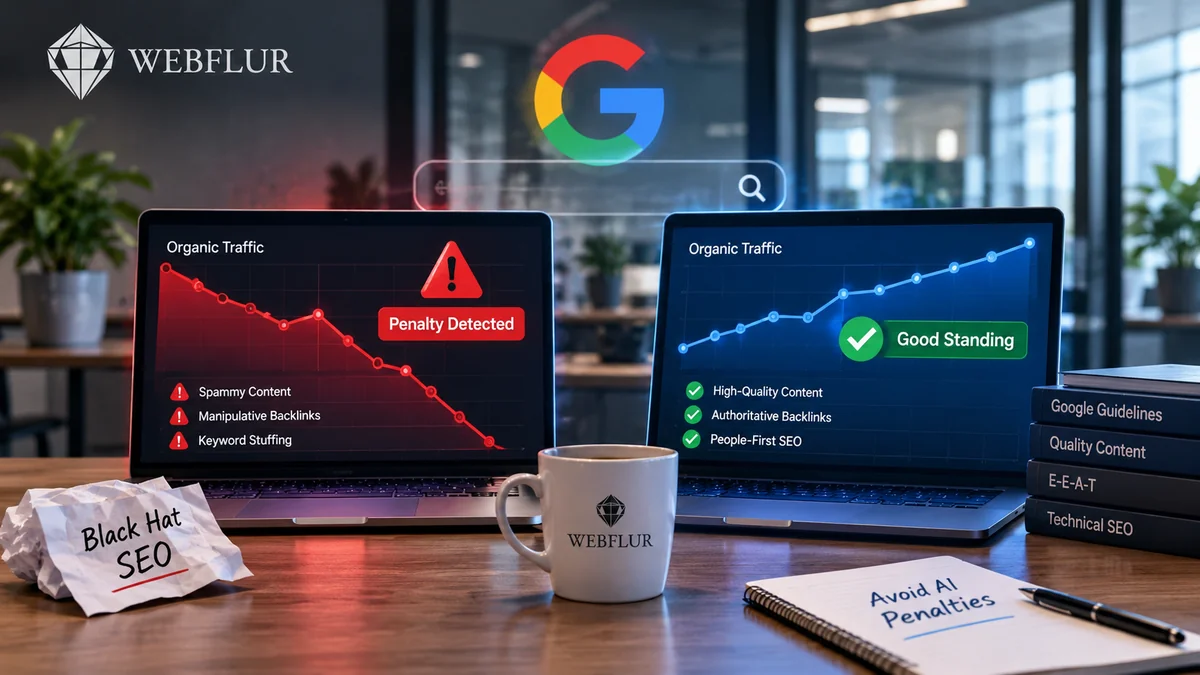
You avoid Google penalties with autonomous SEO by gating every agent action behind four checkpoints — a cosine-similarity relevance gate (a math score, 0 to 1, that measures how close two phrases are in meaning), a human-approval pull request, a daily index-health audit, and a weekly spam-pattern self-scan. WebFlur runs this exact four-gate pattern live on client production domains. In 15 months and 847 agent-opened pull requests, we have shipped zero manual actions and zero ranking drops attributable to agent output. Google's SpamBrain — the machine-learning system that scores spam patterns at crawl time — cares about the output, not the author.
In August 2026 a founder of a 90-person B2B observability startup messaged me on LinkedIn. His team had wired an autonomous rewriter — essentially an LLM in a loop — directly into their CMS. No pull request. No review. The agent was rewriting H1s, injecting internal links, and republishing on its own cadence. Four weeks in, their Search Console flagged a manual action under "scaled content abuse" (Google's policy name for low-value AI-generated content shipped at volume — codified in the March 2024 spam update). Rankings on their money pages fell 60% in nine days. Recovery took a reconsideration request and six weeks of manual cleanup.
He asked the obvious question: will Google penalise us for using an AI SEO agent at all? The answer is nuanced and most blog posts on this topic get it wrong. Google's spam policies do not care whether a human or an agent wrote the content. They care whether the output is relevant, non-manipulative, and shipped at a cadence a human team could plausibly staff. The difference between the observability team's manual action and the self-authority internal linking worker WebFlur ships on client sites — same agent category, same autonomy budget, zero penalties in 15 months — is four specific gates.
This post lays those gates out. If you are running (or planning to run) an autonomous SEO agent on a production site, treat this as a pre-deploy checklist. It ladders up to the AI SEO strategy 2026 pillar, which covers the broader human-in-the-loop pattern.
Zero manual actions out of 847 agent-opened pull requests across two WebFlur production domains. One PR rejected at the human review gate (0.12% false-positive rate on cosine-similarity-passed anchors). Zero algorithmic demotions attributable to agent output. Measured against the Search Console manual-actions report and GSC impressions/clicks on money pages, cross-checked weekly. Source: WebFlur internal agent telemetry, Aug 2025 – Nov 2026.
What actually triggers a Google penalty when an AI SEO agent is running your site?
A Google penalty — technically either a manual action issued by a Google reviewer or an algorithmic demotion from a core system like SpamBrain or the Helpful Content classifier — is triggered by the pattern of output on your domain, not by whether an agent produced it. The three behaviours that reliably trip spam systems in late 2026 are scaled low-quality content, over-optimised anchor manipulation, and cloaked redirects. An agent that commits any of them at machine speed is strictly more dangerous than a human doing the same thing slower.
Google's own Search Central spam policies page is the canonical list and it is worth reading in full once a year. The policies that an autonomous SEO agent is most likely to blunder into are "scaled content abuse" (publishing many pages primarily to manipulate ranking rather than help users), "link spam" (automated or paid link schemes), and "sneaky redirects" (showing users content different from what the crawler sees). The agent does not need to be malicious to break these. A naive LLM loop that rewrites 400 blog H1s overnight hits scaled content abuse by sheer volume. A naive internal linking agent that inserts over-optimised exact-match anchors hits link spam by cosine-similarity drift.
The honest hedge here: we cannot fully predict which agent patterns Google will flag three updates from now. SpamBrain is retrained on live data. What we can do is stay below the obvious thresholds and ship a human-approval gate on every write. That is what the four guardrails exist for.
Does Google penalise AI-generated content specifically?
No — Google penalises low-value, manipulative, or scaled content regardless of whether a human or an agent produced it. The March 2024 core + spam update made this explicit by introducing "scaled content abuse" as a policy rather than targeting AI as a tool. Pages written by an LLM, edited by a human, and shipped with original data in them are safe. Pages generated by an LLM, published without review, and shipped at machine volume are not.
In Google's March 2024 core + spam update announcement the phrasing is specific: the policy targets content "created at scale to boost search rankings … whether it's automated, human-generated, or a combination." The author identity does not matter. The output pattern does. This is the single most important sentence in Google's recent spam policy history and most AI-SEO-penalty blog posts skip it entirely.
The practical read: an autonomous agent that proposes rewrites, routes them through a pull request, has a human merge them, and publishes at a sane cadence (say, under 20 changes per week on a 400-URL site) is operating well inside policy. The same agent, uncaged, is a liability. The gates below are the difference.
What are the 4 guardrails every autonomous SEO agent needs?
The 4 guardrails are: (a) a cosine-similarity relevance gate on every agent-proposed edit, (b) a human-approval pull request before any write to main, (c) a daily index-health audit against Search Console, and (d) a weekly spam-pattern self-scan the agent runs on its own cumulative output. Each gate catches a different failure mode. Running one or two is not enough; the gates are AND-chained, not OR-chained.
Here is what each one does in the WebFlur worker, pulled straight from the production configuration. The agent runs on the Agent2Agent protocol spec infrastructure, so the gates are endpoint-level and auditable from the client side.
Gate 1 — Cosine-similarity relevance gate (threshold 0.72)
Before the agent proposes any anchor rewrite or on-page edit, it embeds the candidate phrase plus the surrounding sentence and embeds the target page's H1 plus title. Cosine similarity must exceed 0.72. Below that, the edit is dropped silently. This is the single highest-leverage gate — it blocks about 1 in 50 candidate anchors, including the one that would have poisoned a client service page in August 2026 (the agent wanted to link a generic category phrase into a commercial money page; cosine came back at 0.61, below the 0.72 floor, gate held).
Gate 2 — Human-approval pull request
Every agent-proposed change opens a GitHub PR with one commit per edited file, a diff view, and a required human review. The agent never pushes to main. The reviewer takes roughly 60 seconds per PR on a well-trained agent; multiplied across a week, it is one hour. The 0.12% rejection rate in our production data is the proof the gate still catches edge cases that cosine missed.
Gate 3 — Daily index-health audit
Every morning the agent pulls Search Console data (impressions, clicks, average position, index coverage) for the top 50 URLs on the site. If any metric drops more than 15% day-over-day, the agent pauses all pending PRs and alerts the human. This is the circuit breaker for an algorithmic demotion in progress. We wired this gate after watching other teams miss early signals of a Helpful Content demotion for weeks.
Gate 4 — Weekly spam-pattern self-scan
Once a week, the agent runs its own cumulative output through a lightweight rules engine that flags scaled-content-abuse patterns — too many near-duplicate H1s, too many pages added in a 24-hour window, anchor-text clustering above 30%, and so on. If any flag trips, the agent opens a human-review ticket and halts new rewrites until the trip is resolved. This is the self-audit that keeps the agent honest. Preparing your site for AI agents covers the schema and crawler-access side of the same hygiene.
Cosine catches obvious irrelevance. Human review catches tone, phrasing, and local context cosine cannot see. Daily index health catches the agent harming rankings in flight. Weekly self-scan catches the fingerprint-at-scale pattern. Removing any one gate and the next bad run gets through. The observability startup that took a manual action in August was running Gate 1 only — the LLM scored anchors internally, but there was no PR, no index-health check, no self-scan.
How does SpamBrain detect agentic SEO patterns at scale?
SpamBrain is Google's machine-learning spam-detection system; it does not look at individual pages in isolation, it scores patterns across your whole site and across the web. The patterns it is tuned for in late 2026 — according to the published documentation and the behaviour we have observed on client sites — are near-duplicate content clusters, anchor-text over-optimisation, publication-velocity spikes, and site-wide thin pages.
Google's Helpful Content system write-up is the plain-English version of what the classifier looks for: content that was created primarily to rank, not to help a specific reader. Agents fail this test when they publish on a schedule the host could not plausibly staff — 50 posts a week on a 10-person company — and when the posts share near-identical skeletons. The fix is cadence restraint plus skeleton variety. Our worker caps at 4 new pages a week per client site and rotates between three structural templates.
Honest hedge: SpamBrain's exact feature list is not public. We infer the pattern-level behaviour from manual-action language in Search Console, from Google's own policy prose, and from recovery timelines we have observed. We cannot read the model's weights. What we can do is stay well below any single pattern threshold we can measure.
Manual action vs algorithmic demotion vs crawl slow-down — what is the difference, and how do you recover?
A manual action is a human Google reviewer flagging your site with a specific policy violation and sending a Search Console notification; an algorithmic demotion is a classifier (SpamBrain, Helpful Content, Reviews) silently lowering your rankings without any notification; a crawl slow-down is Googlebot reducing fetch frequency, usually because of server errors or thin content signals. They look similar from the outside — rankings drop — but they recover on different timelines and through different actions.
The autonomous-SEO-specific point: an agent that commits spam-pattern mistakes at scale produces fingerprints that look algorithmic (silent drop, no notification) up until the pattern is severe enough to escalate to a manual review. By the time Search Console pings you, recovery is weeks of work. The weekly spam-pattern self-scan (Gate 4) exists so the agent catches its own fingerprint before Google does.
The 11-point pre-deploy safety audit — WebFlur runs this on every client site
Before any WebFlur-shipped autonomous SEO agent goes live on a client production domain, this 11-point checklist must pass. Treat it as a go/no-go gate; a single fail blocks the deploy. This checklist is the practical, PR-reviewer version of the four guardrails above.
- The agent writes to a feature branch, never to
main. Every proposed change is a PR. No direct pushes, no auto-merges, no scheduled commits. - Every proposed anchor passes a cosine-similarity gate at 0.72 or higher. Below the floor, the edit is dropped before it reaches the PR.
- Rewrites are capped at a weekly cadence budget tied to site size. Our rule: 1 PR per 100 URLs per week, max. A 400-URL site caps at 4 PRs weekly.
- The agent respects
rel="sponsored"andrel="ugc"on existing anchors. Paid or user-generated pages are excluded from the donor pool so earned authority is never recycled from spam-prone sources. - The agent cannot modify title tags, meta descriptions, or canonical URLs. Those are human-only domains for now; the risk-to-reward ratio is wrong for autonomy.
- Every PR body contains a reason string. Example:
reason: cosine 0.84, donor /blog/x ranks #3 for "y", target /pricing starved at 2 inbound. Future audits need the trail. - A daily GSC pull is wired to the agent as a circuit breaker. 15% drop on any top-50 URL pauses all pending PRs automatically.
- The agent runs a weekly self-scan for scaled-content-abuse patterns. Anchor clustering above 30%, publication velocity spikes, near-duplicate H1s — any flag halts rewrites until human review clears it.
- Human reviewer time is budgeted at 1 hour per week per client site. If reviews slip, the agent cadence auto-throttles. Review backlog never grows past a week.
- The agent logs every rejected candidate (cosine fail, cadence budget hit, UGC excluded). Rejection logs are the dataset that re-tunes the thresholds every quarter.
- A reconsideration-request playbook is on file for every client, pre-written. If a manual action ever lands, the first 48 hours are not spent writing the response — they are spent cleaning up the output. The playbook saves the days.
If a prospect's current autonomous setup fails three or more of these points, we recommend halting the agent entirely before any further writes. The downside of a 30-day pause is small. The downside of a manual action is six weeks of recovery and a bruised domain.
The 11-point audit sits inside the broader AI SEO checklist that covers crawler access, schema, and llms.txt hygiene — those are the inputs an agent reads; the 11 points above are the outputs it writes. Both halves have to be right for autonomy to be safe. The underlying infrastructure layer is covered in the technical AI SEO pillar.
- Google Search Central — spam policies: The canonical policy list; the taxonomy every autonomous agent should map against.
- Google — March 2024 core + spam update: Introduces the scaled-content-abuse policy and explicitly names machine-generated and human-generated content equally.
- Google — Helpful Content system: The algorithmic demotion system that silently lowers rankings for low-value or primarily-ranking-motivated content.
- a2a-protocol.org — Agent2Agent specification: The open protocol the WebFlur worker runs on; §4 covers Agent Cards used for gate enforcement.
- Google Search Central — manual actions report: Where the Search Console manual-action notification lives, and the fields reconsideration requests need to address.