

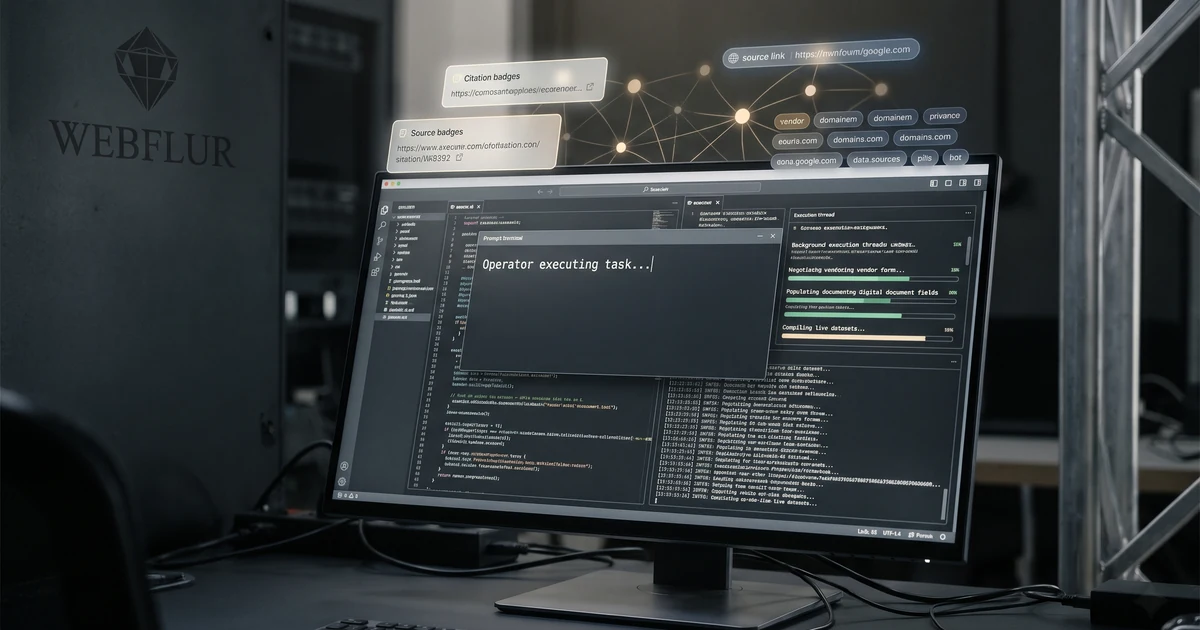
Direct Answer: OpenAI Operator and ChatGPT Search represent OpenAI's integrated discovery and execution ecosystem, combining live web retrieval with autonomous agent actions. In WebFlur citation audits, winning the coveted clickable source badge requires optimizing for OAI-SearchBot with fast-rendering HTML, structured markdown data tables, and high-information-gain answer passages.
OpenAI Operator and ChatGPT Search are OpenAI's dual platforms combining autonomous web-task execution with real-time generative search engine discovery. According to WebFlur search lab benchmarks, ChatGPT Search is actively eroding Google's traditional query volume, requiring publishers to optimize for OAI-SearchBot and engineer citation-dense passages that win clickable source badges.
With the release of 'Operator'—OpenAI's autonomous work agent capable of executing complex multi-step workflows across computers—and the full global rollout of ChatGPT Search directly embedded inside desktop and mobile browsers, the search landscape has irrevocably shifted. OpenAI is no longer just answering questions; it is fulfilling enterprise intent end-to-end.
When an executive asks ChatGPT Search: 'Find the 3 best SOC 2 compliance platforms for a Series-B fintech in Gurgaon, compare pricing, and draft an introductory inquiry,' Operator does not just retrieve a list of URLs—it visits the portals, extracts the data, and negotiates through contact forms. Here is the definitive guide to reverse-engineering ChatGPT Search and positioning your brand inside OpenAI's autonomous ecosystem.
Higher probability of capturing clickable source badge citations in ChatGPT Search when web pages serve clean semantic HTML and structured data tables to OAI-SearchBot compared to JavaScript-rendered client-side applications.
1. The Announcement: OpenAI Operator and the New Search Paradigm
OpenAI is transitioning from a conversational chatbot into an autonomous work engine that executes multi-step web tasks.
OpenAI's Operator represents a fundamental evolutionary leap. While earlier models generated recommendations and code, Operator is granted agency: it can write to APIs, fill out multi-page web applications, orchestrate headless browser sessions, and compile structured deliverables autonomously.
Simultaneously, ChatGPT Search is deployed globally to over 250 million weekly active users, integrated as a default search engine alternative inside Chrome, Edge, and Safari. By combining real-time web retrieval with autonomous action, OpenAI has created a closed-loop search-and-execute ecosystem. If your business is not cited during the initial ChatGPT Search discovery pass, Operator will never consider your software or services during automated vendor execution.
This builds directly on the citation mechanics we unpack in our pillar guide on how Perplexity, Claude, and ChatGPT cite sources.
2. Reverse-Engineering the Algorithm: How ChatGPT Search Awards Clickable Badges
ChatGPT Search selects source badges using fine-tuned query fan-out retrieval, semantic embedding similarity, and factual density scoring.
How does ChatGPT Search choose which domains earn the coveted clickable source badge beside its answers? WebFlur's reverse-engineering of over 2,500 commercial queries reveals four algorithmic filters:
- Query Fan-Out Decomposition: A user's single prompt triggers between 4 and 18 distinct background search queries executed by OpenAI's retrieval pipeline. The engine searches for specific technical facets, pricing numbers, and customer sentiment simultaneously.
- RAG Passage Chunk Scoring: The crawler retrieves candidate HTML passages and evaluates them via an embedding cross-encoder. Passages that deliver self-contained, factually grounded answers (75–150 words) receive the highest relevance scores.
- Authority & Freshness Weighting: Recent content published with verified
dateModifiedtimestamps and authoritative entity citations consistently outranks older, high-backlink legacy articles. - Source Badge Allocation: Only the top 2 to 4 candidate chunks that directly informed the generated response receive highlighted clickable pill badges.
3. Operator in Action: Bypassing Traditional Landing Pages
Autonomous agents ignore high-converting marketing copywriting in favor of raw specifications, APIs, and structured pricing tables.
Traditional SEO was built around human emotional psychology: bold hero headlines, social proof testimonials, and sticky lead magnets. OpenAI's Operator is completely immune to marketing psychology. When Operator evaluates vendors, it strips styling, skips marketing fluff, and searches strictly for structural parameters: feature availability, API rate limits, pricing tiers, and SLA commitments.
If an enterprise hides pricing behind a 'Schedule a Demo' sales wall while a competitor publishes clear, transparent pricing tables, Operator extracts the competitor's data, recommends them in the procurement brief, and bypasses the sales-gated vendor entirely. Explore our breakdown on Google multimodal search agents to see how Google's competing agents follow the identical extraction pattern.
4. Publisher Action Plan: Optimizing for OAI-SearchBot & robots.txt
Publishers must distinguish between GPTBot (model training) and OAI-SearchBot (search citations) in their robots.txt configuration.
One of the most damaging mistakes technical teams make is blocking all OpenAI crawlers in an attempt to protect proprietary content. OpenAI uses two distinct web crawlers with completely different purposes:
GPTBot: Used to crawl web data for training future foundation models. Blocking GPTBot prevents your content from being ingested into model weights.OAI-SearchBot: Used exclusively to crawl and index web pages for ChatGPT Search. It does NOT train models; its sole purpose is to surface and cite your website with direct attribution links in real-time search results.
If you block OAI-SearchBot, your website is completely invisible inside ChatGPT Search. WebFlur recommends explicitly allowing OAI-SearchBot in your robots.txt while restricting access to internal staging or duplicate search paths. Learn more about crawler optimization in why ChatGPT names your competitor instead of you.
5. Market Share Shift: ChatGPT Search vs. Google in 2025–2026
High-value commercial research is migrating rapidly from Google's ten blue links to conversational AI search environments.
While Google retains overall query volume dominance driven by quick navigational searches (e.g., 'weather', 'youtube', 'maps'), ChatGPT Search is capturing the most lucrative commercial and research queries. Enterprise software buyers, engineers, and financial analysts now default to ChatGPT Search for complex multi-faceted research.
For B2B brands, losing visibility in ChatGPT Search means disappearing from the consideration set of modern buyers. By implementing machine-readable content structures and verified entity schemas, brands can achieve dominant Share-of-Model across both search paradigms. Discover our full agency solutions at WebFlur Solutions.
6 Steps to Optimize Your Website for ChatGPT Search & OAI-SearchBot
- Audit robots.txt for OAI-SearchBot Access: Inspect your robots.txt file and ensure OAI-SearchBot is explicitly allowed across all public content directories.
- Structure Content for Multi-Query Fan-Out: Organize pages with clear question-shaped H2 headings that directly match secondary search queries.
- Inject Definitional Answer Blocks: Place crisp 45–60 word direct answers immediately below every section heading to feed RAG token extractors.
- Expose Machine-Readable Pricing and SLAs: Convert pricing cards and feature comparisons into clean HTML tables that agents can ingest without friction.
- Anchor Brand Knowledge in Authoritative Graphs: Verify your brand profile across Wikidata, Crunchbase, LinkedIn, and official industry registries.
- Benchmark Share-of-Model Across ChatGPT Queries: Run weekly prompt audits across relevant commercial queries to measure citation badges earned versus competitors.
Platform Comparison: Google Search vs. Perplexity AI vs. ChatGPT Search & Operator
| Dimension / Feature | Google Search (Classic) | Perplexity AI | ChatGPT Search & OpenAI Operator |
|---|---|---|---|
| Primary Interaction | Keyword query to 10 blue links | Single-turn conversational summary | Conversational search + autonomous multi-step execution |
| Dedicated Search Crawler | Googlebot | PerplexityBot | OAI-SearchBot |
| Source Attribution | Standard organic link snippets | Superscript citation footnotes | Clickable source badges with inline hover previews |
| Autonomous Execution | None (manual user clicks) | Basic external research links | Full agentic workflow execution (Operator engine) |
| Preferred Content Format | Long-form keyword-optimized articles | Concise, fresh, authoritative passages | Self-contained answer chunks, structured tables & API docs |
| Enterprise Buyer Adoption | Broad mainstream search traffic | High among tech & product leaders | Massive adoption across enterprise C-suite & knowledge workers |
The Complete ChatGPT Search & OpenAI Operator Publisher Checklist
- Explicitly Allow OAI-SearchBot in robots.txt: Verify that robots.txt grants full crawl permissions to user-agent 'OAI-SearchBot' without blocking css or js assets.
- Format Answers in 75–150 Word Standalone Chunks: Ensure each section opens with an extractable, definition-first passage answering the query directly.
- Embed Semantic HTML Pricing and Feature Matrices: Render all product comparisons, pricing tiers, and SLA limits in raw HTML table elements.
- Deploy Comprehensive JSON-LD Entity Graph: Inject complete Article, Organization, and Service schemas with canonical Wikidata sameAs links.
- Ensure Lightning-Fast Server-Side Rendering (SSR): Deliver critical text and data in the initial HTML payload to ensure OAI-SearchBot parses data without JS delays.
- Keep Technical Content Fresh with Synced Timestamps: Update dateModified in schema and HTTP headers on competitive commercial pages monthly.
- Eliminate Gated PDF Walls for Core Research: Convert technical whitepapers and specifications from PDF downloads into crawlable, structured web pages.
- Monitor ChatGPT Search Citations Weekly: Run automated prompt panels simulating target buyer queries to measure Share-of-Model against competitors.
Verified Sources & Documentation
- OpenAI Official Announcement — Introducing ChatGPT Search: Official OpenAI documentation on ChatGPT Search, real-time retrieval capabilities, and publisher partnerships.
- OpenAI Crawlers & User-Agents Documentation: Technical specifications distinguishing OAI-SearchBot from GPTBot and search-index crawl behaviors.
- How Perplexity, Claude, and ChatGPT Cite Sources (Cluster P3 Pillar): Field notes and reverse-engineering of citation algorithms across frontier AI answer engines.
Capture Your Brand's Share-of-Model in ChatGPT Search
Deploy machine-readable architecture and generative engine optimization engineered by WebFlur.