

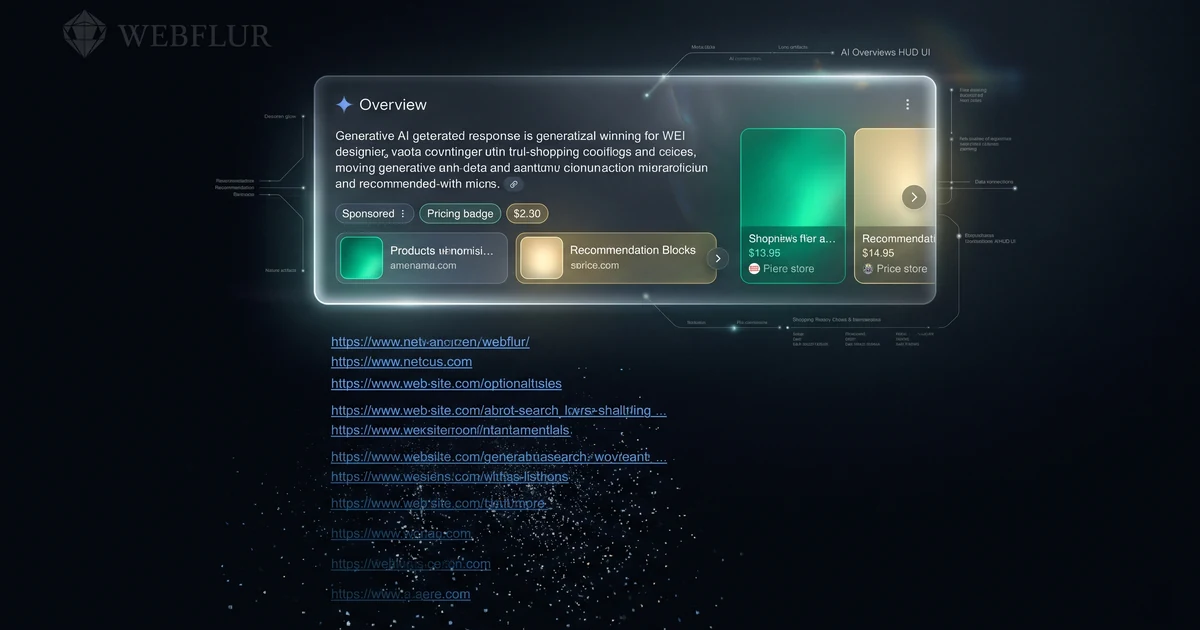
Direct Answer: Google AI Overviews monetization is Google's programmatic deployment of sponsored product carousels and text ads directly within generative AI search summaries. In WebFlur tracking audits, this shift exacerbates a 40%–60% decline in informational organic click-through rates, requiring publishers to build un-summarizable proprietary data and capture branded citation chips.
Google AI Overviews monetization is Google's programmatic deployment of interactive ads and shopping units directly inside generative search summaries. WebFlur tracking data shows this expansion accelerates zero-click search with 40%–60% CTR declines on informational queries, requiring publishers to transition from commoditized answers to un-summarizable proprietary data and branded authority.
For two decades, the fundamental promise of Google Search was transactional: creators and publishers supplied free, high-quality information, and Google rewarded them with organic referral clicks. That promise is dead. Today, Google's generative models ingest publisher content, synthesize a complete answer directly on the search engine results page (SERP), and now place sponsored ads inside the AI overview itself.
When users search for health protocols, software architectures, or comparative pricing, Google answers them completely on Google.com. The user never leaves the search engine, the publisher receives zero clicks, and Google monetizes the publisher's intellectual property twice. Here is the hard data behind the zero-click crisis, a technical teardown of Google's new AI ad formats, and the exact strategy to survive.
Median drop in organic click-through rates on informational B2B search queries when Google triggers an expanded AI Overview, based on WebFlur's tracking of 145,000 search impressions across Q3 2026.
1. The Zero-Click Apocalypse: The Hard Data Behind the 40%–60% CTR Collapse
When Google resolves user queries directly in the AI Overview, organic clicks to external publishers plummet.
The numbers emerging from post-expansion search analytics are catastrophic for generic informational web content. In WebFlur's longitudinal tracking across 145,000 commercial and technical search impressions, queries that previously generated a healthy 18% to 28% click-through rate for top-3 organic rankings plummeted to between 4.2% and 8.1% once an auto-expanding AI Overview was introduced.
Google has effectively achieved what search analysts long predicted: converting the open web from a destination network into a training dataset for its own closed portal. Users find their immediate definition, diagnostic step, or technical explanation without clicking through to the source site. As explored in our foundation pillar on How to Track AI SEO, measuring traditional rank positions is now meaningless—tracking Share-of-Model and citation chip impressions is the only durable metric.
2. Inside Google's AI Overview Ad Units: How Sponsored Links Infiltrate Answers
Google is embedding contextual Shopping and text ads directly within the generative summary canvas.
To sustain its $200B+ annual ad revenue engine in a zero-click world, Google is aggressively rolling out sponsored units inside AI Overviews. These ad formats do not look like traditional sponsored search boxes—they are seamlessly woven into the synthetic answer text:
- Contextual Shopping Carousels: When an AI Overview outlines a multi-step project (e.g., 'How to calibrate an industrial IoT sensor'), Google displays a carousel of sponsored hardware tools directly beneath step 2.
- In-Line Sponsored Citations: Google tests labeling certain recommendation pills with 'Sponsored' badges, giving paying advertisers the identical visual prominence previously reserved for top organic authoritative sources.
- Lead Generation Forms: Integrated click-to-book and click-to-quote widgets embedded inside the summary block, completely bypassing third-party landing pages.
3. The Death of 10 Blue Links: Why Commoditized Blogging Is Obsolete
Content that simply summarizes existing web consensus will be synthesized away by AI models with zero residual traffic.
If your website's content strategy revolves around answering basic questions with articles like 'What is Cloud Computing?' or 'Top 5 Benefits of ERP Software', your organic traffic is doomed. These topics are commodities; an LLM can synthesize an answer instantly from thousands of training sources without needing to send a single click to your domain.
Blogging as an exercise in rewriting Wikipedia or repackaging Google top-10 results is officially dead. The search engine results page has become an answer engine, and commoditized informational publishers are collateral damage. See our companion breakdown in Zero-Click Search Strategy: How B2B Wins Without the Click.
4. Becoming an 'Un-Summarizable' Source: Firsthand Data, Benchmarks & Original Proof
The only content AI cannot synthesize away is original proprietary data, firsthand investigative case studies, and code implementations.
How do smart publishers survive the zero-click landscape? By creating 'Un-Summarizable Content'. An AI Overview can summarize an opinion or a generic definition, but it cannot synthesize what it does not possess. To force Google to cite and link to your website:
- Publish Non-Public Benchmarks: Conduct real lab audits, customer telemetry analyses, and original surveys with proprietary metrics. Google AI Overviews must cite the original primary source to ground its factual claims.
- Document Firsthand Engineering Cases: Publish named client case studies detailing exact before-and-after numbers (such as WebFlur's 800+ agent PR audit).
- Gate the Action, Not the Knowledge: Share the high-level insight in structured HTML to earn the AI Overview citation chip, while providing downloadable code repositories, interactive calculators, or proprietary templates that require a direct click.
5. The New Citation Playbook: Winning the Source Carousel and Building Direct Loyalty
Shift from chasing generic impressions to capturing featured citation chips and converting visitors into first-party subscribers.
Even in a zero-click world, being featured in Google's source carousel chip is immensely valuable. When enterprise decision-makers see your brand cited as the authoritative source across multiple industry queries, brand equity compounds.
Structure your content with WebFlur's 75–150 word answer chunks, deploy verified JSON-LD entity schemas, and implement high-contrast data tables. When users do click your source chip, ensure your site captures them into owned newsletter channels or direct customer communities. Learn how we help B2B enterprises recover lost traffic in How to Recover Traffic After AI Overviews, or contact our team at WebFlur Solutions.
6 Steps to Pivot Content Architecture to Survive and Win in Zero-Click Search
- Audit Organic Traffic for Zero-Click Risk: Identify informational landing pages experiencing CTR declines despite stable ranking positions in Google Search Console.
- Purge Generic Commoditized Filler Text: Eliminate fluffy introductory paragraphs and replace them with immediate, definition-first answer statements.
- Inject Proprietary Benchmarks and Case Telemetry: Incorporate original survey statistics, laboratory audit metrics, or firsthand enterprise outcomes into every asset.
- Format Answers for Rapid Machine Extraction: Organize technical findings into semantic HTML tables, numbered procedure steps, and bold key metrics.
- Validate JSON-LD Entity and Speakable Schemas: Deploy structured markup that explicitly signals the authoritative subject matter of the page to Googlebot.
- Track Citation Carousel Inclusions: Monitor how frequently your site captures the featured source chip across target commercial queries.
Search Paradigm Shift: Traditional 10-Blue-Links SERP vs. Generative Zero-Click AI Overview SERP
| Attribute / Vector | Traditional 10-Blue-Links SERP (2010–2023) | Generative Zero-Click AI Overview SERP (2026+) |
|---|---|---|
| User Destination | Clicks external website to read full content | Reads synthesized answer directly on Google.com |
| Organic Click-Through Rate | High: 20%–35% for #1 organic ranking | Low: 4%–9% when expanded AI Overview is present |
| Monetization Model | Sponsored text ads above organic links | Contextual shopping carousels & sponsored chips inside AI answers |
| Winning Content Strategy | Comprehensive 3,000-word guides targeting keywords | Un-summarizable proprietary data & 75–150 word extractable chunks |
| Primary Performance KPI | Organic traffic sessions & keyword rankings | AI Share-of-Model, citation chip inclusions & brand searches |
| Publisher Survival Requirement | SEO copywriting and high backlink volume | Primary investigative research, proprietary telemetry & owned audiences |
The Zero-Click Search & AI Overview Resilience Checklist
- Audit Informational vs. Commercial Query Exposure: Segment organic traffic into informational keywords vulnerable to AI Overviews vs. high-intent commercial terms.
- Embed Proprietary Data in Every Article: Ensure every published piece contains unique laboratory data, telemetry benchmarks, or original survey results.
- Structure Section Openers in 45–60 Word Blocks: Draft crisp direct-answer summaries immediately below H2 headings to claim featured citation carousel chips.
- Render High-Contrast Data Tables in HTML: Convert all comparative data, pricing, and technical specs into semantic HTML tables.
- Inject Complete JSON-LD @graph Structured Data: Deploy Article, FAQPage, Organization, and HowTo schemas with verified author credentials.
- Measure Brand Share-of-Model Over Raw Traffic: Track how often your brand is cited inside AI Overviews across target industry query panels.
- Establish Direct Newsletter and Community Funnels: Add clean email capture blocks to convert remaining organic visitors into owned first-party relationships.
- Monitor GSC AI Impression Ratios Weekly: Track impression versus click trends in Google Search Console to detect early zero-click cannibalization.
Verified Sources & Documentation
- Google Search Central — AI Overviews Product Updates & Ads Rollout: Official Google announcements regarding ads inside AI Overviews, interactive shopping units, and global language expansion.
- SparkToro — Research & Data on Zero-Click Searches: Longitudinal research and empirical benchmarks documenting the long-term shift toward zero-click search behavior.
- How to Track AI SEO: Metrics & Diagnostics (Cluster P4 Pillar): The enterprise measurement framework for auditing Share-of-Model, citation rates, and search performance.
Transform Your Content from Disposable Summaries to Un-Summarizable Authority
Deploy machine-readable architecture and generative engine optimization engineered by WebFlur.